
 Axe ’Em, Jacks!
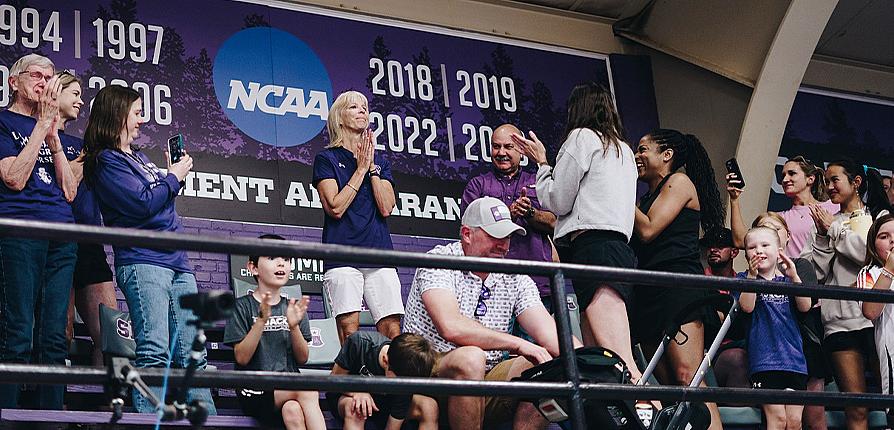
Debbie Humphreys, center, stands in amazement after the newly dubbed Debbie Humphreys Court was unveiled in Shelton Gym May 3, 2025. Humphreys currently has the second most wins among active coaches with 846 and is the only coach with at least 800 wins at one institution.
Debbie Humphreys' record-breaking career recognized with lasting tribute
Story by Nathan Wicker '19
Photos courtesy of SFA Athletics
For the first time in her 37-year career, Debbie Humphreys didn't know what to say.
She thought it was just another run-of-the-mill ceremony — a routine unveiling of Shelton Gym's new Taraflex court, the gold standard in collegiate volleyball surfaces and the only institution in the Southland Conference to boast such luxury.
Settling into a seat alongside her coaching staff, players, family, fans and members of the Department of Athletics, Humphreys was eager to finally lay eyes on the finished design she helped choose. As her gaze drifted to the center logo, faintly visible beneath the coverings, everything felt exactly as expected — nothing out of the ordinary, at least not yet.
Then, the tarp was pulled.
The crowd inside Shelton Gym erupted — all rising to their feet. And there it was, permanently stamped on both ends of the court in regal cursive lettering: "Debbie Humphreys Court."
This wasn't just a court unveiling. It was a tribute to a legacy — nearly four decades of leadership, 846 wins and counting, and a name forever etched onto the very floor she helped build.

Roots before the rally
Born in Olney, Illinois, and raised two hours north in Rochester, Humphreys found her way to sports early, rekindling memories of evenings on the back deck with her father listening to St. Louis Cardinals broadcasts, serving as a golf caddy for her parents and shooting hoops in the driveway until the light faded.
If there was a sport to play, she played it, and by the time the stat sheets were printed — whether from an organized sport or in the metaphorical sense from the neighborhood game of kick-the-can — chances were, Humphreys' name was on them. But it was in seventh grade, when she first stepped onto the court for organized volleyball, that things truly began to take shape.
"I was going to play whatever opportunities were there," Humphreys said. "Volleyball seemed to be the one that just stuck and the one I was best at. It became what I wanted to do."
"My game was more like my coaching style: guts and grit," Humphreys said in an interview on SFAVolleyblog.net. "I think I was more of a glue piece. I think I was a glue-type piece that allowed some of those crazy good athletes and good players that I played with to do their thing."
An outside hitter who found ample success through the middle and high school ranks, Humphreys pursued her desire to continue playing volleyball collegiately. To do so, she began learning the setter position with advice from a club coach and traveling throughout Illinois and Missouri for tryouts. During that time, women's collegiate volleyball championships were conducted by the Association for Intercollegiate Athletics for Women, or AIAW, before the NCAA began offering the sport in 1981.
It was during a club tournament in Kansas City, Missouri, however, that Humphreys first caught the attention of Texas Tech University. What followed was an 18-hour drive south and a dramatic shift — trading the wooded hills and warm summers of Central Illinois for the arid, sunbaked plains of West Texas. It was, in every sense, a culture shock.
"We came down to Lubbock and we saw it and I thought I had fallen off the face of the Earth because West Texas is its own animal," Humphreys said. "I mean the people were great, but it was flat. There's no trees. The wind blows all the time. It was like, 'wow, this is so different.' But, you know, I ended up taking that opportunity."
Known for her ball control but slightly undersized for the front row, Humphreys transitioned from setter back to an outside hitter position and later garnered All-Southwest Conference honors in 1985. According to Humphreys, if the libero position had existed at the time, that likely would have been her role.
"My game was more like my coaching style: guts and grit," Humphreys said in an interview on SFAVolleyblog.net. "I think I was more of a glue piece. I think I was a glue-type piece that allowed some of those crazy good athletes and good players that I played with to do their thing."
When setting foot on campus, coaching wasn't the plan. Not even a thought. Instead, after a brief dabbling in computer science, she shifted her focus to exercise science with a path toward the medical field. During graduate school, she even worked in cardiac rehabilitation at a nearby hospital.
Despite the sense of accomplishment after successfully interpreting electrocardiograms, a new idea began to take hold — the thought of coaching. Once it entered her mind, she couldn't shake it.
A career above the net
Following a year as a graduate assistant for the Red Raiders, Humphreys scoured assistant coaching listings, with little to show for it. Then something caught her eye: the head coaching gig at SFA.
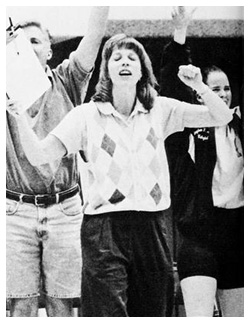 Thoughts began swirling. "Where's Nacogdoches?" "How in the world do you pronounce that?" "They surely wouldn't hire a 23-year-old right out of college, would they?"
"Why not?"
On a whim — and with little expectation — she threw her name in the hat. Weeks later, to her surprise, she received a call from Sadie Allison, former Ladyjacks athletic director and softball and badminton coach. Interviews followed. Then came the offer. Just like that, she was a head coach — unknowingly taking the first step in what would become a remarkable career.
"It's probably extremely rare for a head coach to be hired right out of college, especially in this day and age," Humphreys said. "But it's not the same game as it was back then."
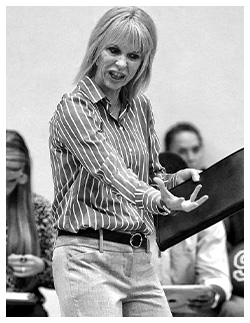 She began piecing together her coaching style, values and philosophy, building upon things she liked from past coaches, and avoiding facets she didn't. The result was a lasting tradition of excellence — built on a drive to excel in every aspect; a commitment to recruiting not just athletic talent but coachable, all-in players; and a deep reliance on the relationships that define the program.
"We've got to have people who truly are striving to be excellent in all aspects of life, because I fully believe they're not going to give us 100% on the court if they're not also giving 100% in the classroom," Humphreys said. "You're either all into what you're doing or you're not."
Guided by these core values, Humphreys quickly led the volleyball program to success, earning her first collegiate win in straight sets over Houston Baptist University, now Houston Christian University, on Sept. 13, 1988.
From there, Humphreys and the SFA volleyball program began their ascent to the upper echelon of mid-major collegiate volleyball.
Of all the milestones in the program's storied career, a few still bring a proud smile to Humphreys' face: SFA's first conference title and NCAA Tournament berth in 1994, the program's historic first NCAA Tournament win in 2006 over The University of Alabama, and the thrill of back-to-back tournament appearances in 2018-19 and again in 2022-23. Each moment a testament to the program's evolution.
"I've come across very few coaches as respected and admired as Debbie Humphreys, and not just in volleyball, but all college athletics," said Michael McBroom, SFA director of athletics. "She has such high standards for excellence, has stayed true to her core values, treats everyone with respect but also holds them to a higher standard. As a coach, she has an incredible ability to get young players and young coaches to believe in themselves and do more than they ever thought they could do."
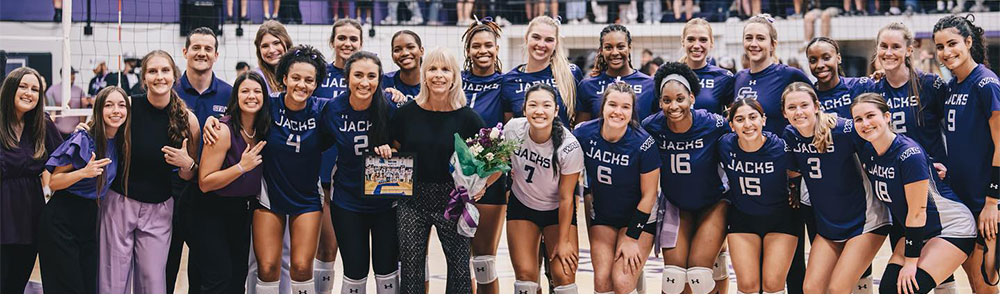
Despite the achievements on the court, "success" to Humphreys isn't the 800+ wins. It's not the overflowing trophy case — it's the lifelong bonds, the growth she's witnessed and the impact that stretches far beyond the court.
"Success is tied more to the relationships than it is to anything else," Humphreys said. "Did we create an environment where they were great teammates to each other and wanted to take care of each other? To me, if we've done that and have people doing things the right way — and we happen to fall short on the scoreboard — we still have been successful."
According to Ariana Pagan '23 & '24, an outside hitter from 2019-2023, Humphreys' high standards shaped the players into champions on and off the court.
"Coach Humphreys is the definition of dedication — disciplined, organized and relentlessly driven," Pagan said. "She shows up every single day, not just to run a practice, but to shape us into champions on and off the court. Her high standards aren't pressure, but belief. She sees the best in us, pushes us to reach it, and never settles for less because she knows greatness is within our reach. Year after year, she continues to build a legacy, and I am proud to be a part of it."
Voice behind the volley
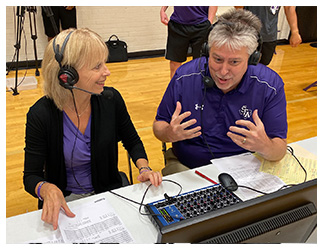
Dr. Greg Miller's office overlooks Shelton Gym, and aptly so.
A professor in SFA's Department of Mathematics and Statistics, when he's not breaking down equations during a lecture, Miller is calling the action as SFA's longtime play-by-play commentator on ESPN+ and internet radio via SFAVolleyblog.net — a platform he launched in 2009 to record and celebrate SFA's often unfaltering program.
Aside from Humphreys, it's likely no one has seen more SFA volleyball over the past two decades than Miller. And throughout his countless hours of writing articles, calling games, and enduring the long bus rides with the team, he has gained something truly valuable — Humphreys' trust.
"It's not just lip service at creating a family atmosphere," Miller said about Humphreys. "She values having loyal people around her. And I think through all these years, that's given me enough time to prove my loyalty to the program. She has a high deal of respect for people that are devoted to the program as a whole."
Now, in his 29th year at SFA, Miller considers Humphreys not only a friend, but one of the three people who have most influenced his time at the university. In his eyes, she's an all-star, a permanent fixture at SFA, and, perhaps most fittingly, an architect of excellence.
"Debbie has a way of consistently maintaining excellence," Miller said. "It's one thing to build a program. It's another thing to maintain the excellency of a program for decades and decades and decades. And that's what's been true. There have been very few periods when the program has seen a two-year dip. That's been one of her greatest attributes — she's an architect."
Match point
When she finally stood from her seat at the unveiling, Humphreys didn't have any words — she just looked at the court with eyes wide and her hands covering her mouth.
She had known every inch of that court — every sideline, every scuff mark, and every spot where a player dove for a well-earned point. But nothing prepared her for this. And for once, the woman who spent a career inspiring players and coaches with her voice couldn't find the words.
"I'm rarely at a loss for words," she said to a packed Shelton Gym. "I have lots of words, but not right now. I'm beyond thankful for what everyone in this room means to me and even to those that could not be here."
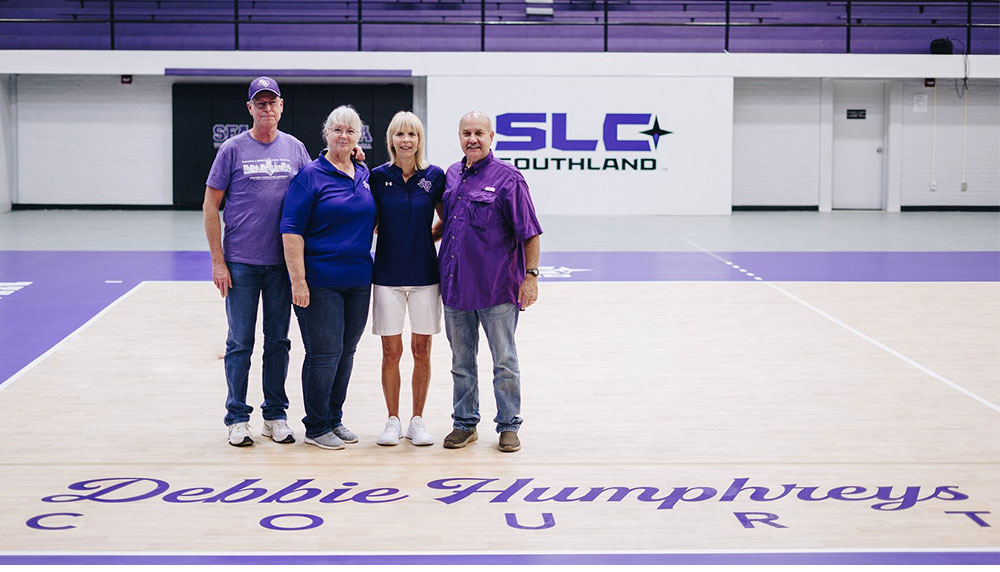
Generous donors Alan and Kim Jones, left, with Debbie and Richard Humphreys
The decision was an easy one for McBroom, Department of Athletics administration, and Alan and Kim Jones, the generous donors who funded the new court.
"The volleyball court has been and will continue to be her office, her lab and her home, and is the place so many incredible moments in volleyball have occurred," McBroom said. "Thus, Debbie Humphreys Court is a representation of her values and standards. She is unique to the volleyball world and epitomizes the values and standards we should all aspire to at SFA."
It will forever be known to Lumberjacks — now and for generations to come — as "Debbie Humphreys Court at Shelton Gym."
"I feel extremely blessed," Humphreys said. "We always talk to our current players about how they're a part of something that's way more than just those of us who are in this locker room on any given day. They're part of a very large SFA volleyball family. So, I would hope that future generations would know that. I would hope they realize it's their responsibility to keep that tradition of excellence going."