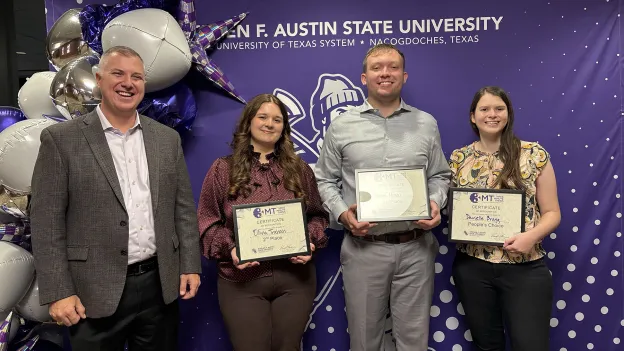
NACOGDOCHES, Texas –– Students in Stephen F. Austin State University’s Master of Science in biology program swept the top three places in the university’s third-annual Three Minute Thesis competition hosted by SFA’s Research and Graduate Studies in November.
Michael Musal, from Le Claire, Iowa, received first place and a $1,000 scholarship for “Big data from a small device: PIT tagging and fish movement”; Olivia Trahan, of Garner, North Carolina, earned second place and a $500 scholarship for “Thinking through the noise: Effects of man-made noise on short-term memory in bottle-nosed dolphins”; and Danielle Bragg, from San Antonio, received the People’s Choice Award and a $250 travel grant to attend a conference of her choice for “Uncovering hidden diversity within underwater caves in Mexico using environmental DNA.” Musal is mentored by Dr. Carmen Montaña-Schalk, associate professor of biology; Trahan is mentored by Dr. Jason Bruck, associate professor of biology; and Bragg is mentored by Dr. Fernando Calderón Gutiérrez, assistant professor of biology.
Developed by The University of Queensland in Australia in 2008, the 3MT® competition model cultivates students’ academic, presentation and research communication skills. Now a global competition, 3MT events are held at more than 900 institutions across more than 85 countries.
“Contestants can use only one static slide — they can’t incorporate props or music in their presentations,” said McKenzie Rogers, graduate program coordinator for Research and Graduate Studies. “And they can’t use notes. They must memorize their presentations, which must stay under three minutes or they’re disqualified.”
Dr. Forrest Lane, dean of Research and Graduate Studies, acknowledged how challenging the competition was for the 17 master’s and doctoral student participants and praised their willingness to engage in this skill-building opportunity.
“This is an incredibly hard thing to do, and I thank you for all the work you’ve put into this,” he said. “It’s not only incredibly important for us to hear about the work you’re doing, but it’s also critical for you to develop the skills you need to present an elevator speech about your research. As you move into your career, those skills will help you secure funding for these activities. You’ll be able to communicate with policymakers who are short on time about the importance of your work. These skills are so crucial, and we’re glad to provide a venue in which to develop them.”
Student presentations, supported by their faculty mentors, covered a wide range of disciplines including cybersecurity, history, psychology, school and health service psychology, and social work.
Judges for the competition were Dr. Elisabeth Ploran, dean of SFA’s College of Health Professions; Dr. Diego Rocha, assistant professor of forest resource management at SFA; and Darius Tubbs, former coordinator of SFA’s 3MT competition and current dean of students at Raguet Elementary School in Nacogdoches.
The judges considered the following questions when determining contestants’ scores: Did they provide a clear explanation of their research that everyone could understand? Did they explain their strategy, design and any results they may have? Was the oration delivered clearly and appropriately, and did the PowerPoint slide enhance the presentation?
The winner, Musal, lured in judges and attendees with his opening line: “If it’s one thing fish and people have in common, it’s that they’ll travel crazy long distances for food and love.”
He’s studying the seasonal movements of the spotted sucker fish, which will travel 100 miles to reproduce or find new resources, to better understand its habitat use and reproduction in the Neches and Sabine river basins.
According to Musal, the spotted sucker is a “species of greatest conservation need” in East Texas because the development of dams and changing drought conditions have led to disconnected river and stream systems that could potentially prevent the species’ migration. His tracking of the spotted sucker’s movements involves injecting a passive integrated transponder, or PIT, tag in the fish’s muscle.
“These tags are the size of a grain of rice, and they’re like a dog microchip,” Musal said. “Scanning it provides you with the fish’s unique identification number. When we get a recapture, we can see where that fish has moved in the past.”
Over the summer, Musal’s research team tagged more than 120 individual spotted sucker fish at 20 study sites, including locations in Lanana Creek and the Angelina River.
“Already, we’ve tracked the movement of one fish 3 miles heading from Lanana Creek toward the Angelina River in a little over a month,” he said. “That’s pretty impressive for a fish that’s smaller than a football.”
Musal hopes that in addition to tracking seasonal movements, his research will help provide growth rates and estimate population size, which is critical for conservation and habitat protection and restoration.
“Ultimately, by using these tiny tags to track the movement of these fish, our results will be a big help in saving the suckers of East Texas,” he said.
Next, Musal will represent SFA at the regional-level competition during the Conference of Southern Graduate Schools in February in Arlington, Virginia. He will compete against graduate students from more than 15 Southern states and the District of Columbia.
Last year, Callie Lynn, SFA biology graduate student from Rusk, was the sole master’s student along with 11 doctoral students to advance to the finals in the regional competition in Baton Rouge, Louisiana.
For more information on SFA’s Research and Graduate Studies, visit sfasu.edu/orgs.