
 Axe ’Em, Jacks!
NACOGDOCHES, Texas –– Tokenized deposits. Bitcoin. Stablecoin.
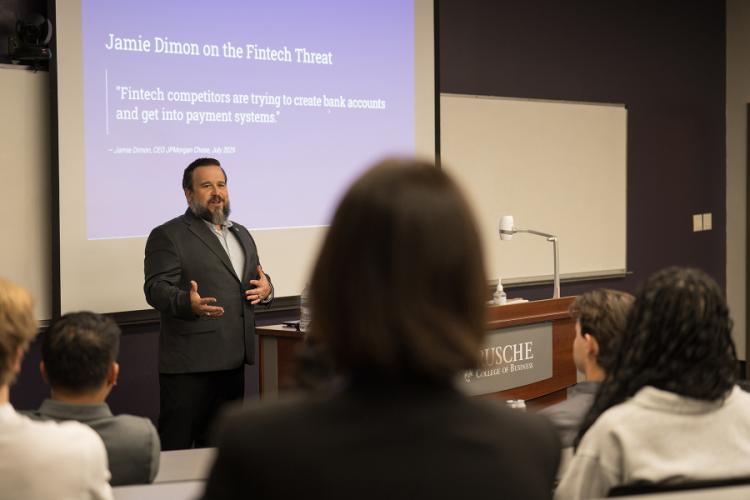
Rich Perez, vice president of innovation and strategy at the Texas Bankers Association, helped local bankers and Stephen F. Austin State University students demystify those terms and understand their impacts at a recent banking and wealth management career day hosted by the Nelson Rusche College of Business’ Chadwick Banking Program.
“By bringing in experts like Mr. Perez, the Chadwick Banking Program helps students gain understanding of the many complex issues facing banking today and exposes them to how the industry collaborates with technology companies, legislators and industry regulators to ensure the safe and sound implementation of technological innovation in this dynamic industry,” said David Kaiser, director of the Chadwick Banking Program.
Perez encouraged attendees to watch banking closely.
“I’ve never seen the industry change so much so quickly,” Perez said. “Students, you are entering the market at a really interesting time. There’s so much opportunity out there. Continue to dig into it.”
During his presentation, sponsored by SFA’s Chadwick Banking Program and Rusche Finance Club, Perez first explained the difference between different types of digital assets. Those used in the U.S. include tokenized deposits, which are gaining recognition among banks as a logical next step in payments modernization rather than a speculative technology.
“This is just digitizing dollars in your reserves,” Perez said. “Nothing more.”
Another digital asset, cryptocurrency, is decentralized and volatile. One type of cryptocurrency, bitcoin, traded as high as $126,000 in October 2025 but had fallen to $70,000 by mid-March.
Stablecoins are a category of digital asset designed to maintain a stable value, typically pegged 1:1 to the U.S. dollar.
“It’s a dollar that moves like email,” Perez said. “It’s instant, borderless, 24/7 and not a commodity.”
Though considered more stable than speculative cryptocurrencies, stablecoins are currently issued primarily by nonbank entities including Circle, which issues USDC, and Tether. These companies are not subject to the same regulatory standards as banks insured by the Federal Deposit Insurance Corporation, or FDIC. This disparity contributed to the passage of the Guiding and Establishing National Innovation for U.S. Stablecoins Act, or GENIUS Act, in July 2025.
However, advocates including the Texas Bankers Association argue that the legislation contains regulatory gaps that create an uneven playing field between nonbank stablecoin issuers and FDIC-insured institutions. Without the same reserve, oversight and consumer protection standards that banks must meet, these gaps pose real risks to consumers who may not realize their funds lack the protections they expect. TBA has made multiple visits to Washington, D.C., to advocate for stronger oversight that levels the playing field and ensures consumers are protected regardless of who issues the stablecoin.
Perez reviewed four ways stablecoins threaten the community bank community.
1. Deposit flight: Financial technology companies, or fintechs, offer high-interest reward programs that allow users to earn stablecoins in exchange for using specific platforms, holding balances or engaging in partner activities. These reserves are not FDIC insured.
“There’s the potential for a $6.6 trillion deposit outflow from the traditional U.S. banking system because of stablecoins in their current unregulated state,” Perez said.
2. Payment disintermediation: Traditional financial institutions are being replaced by nonregulated fintech platforms for transactions like wire transfers and Automated Clearing House, or ACH, banking.
“Banks’ commercial customers may already be looking elsewhere for these services,” Perez said.
3. The legacy infrastructure gap: Community banks typically do not have the resources to adopt the new technologies used by well-funded fintechs and integrate them with traditional banking systems.
4. Vast and barely regulated competition: Nonbanks are offering bank-like services and applying for digital bank charters from the Office of the Comptroller of the Currency. Coinbase, Payoneer, Meta and Walmart are examples. Unlike FDIC-insured institutions, these entities operate without the consumer protections customers expect and often assume they have.
“This is a 360-degree competitive threat,” Perez said. “For example, Walmart is building a payment infrastructure that bypasses banks entirely.”
Meanwhile, states like Wyoming are beginning to issue their own stablecoins.
“The lack of a common standard has created fragmentation across the entire payments ecosystem,” Perez said. “That’s what makes a clear, balanced federal framework important.”
The GENIUS Act was designed to officially define and regulate how payment stablecoins are issued, backed and managed to ensure financial stability and consumer protection.
“We were excited when it was first drafted, but competitors have found loopholes, and they are exploiting them,” Perez said.
Scheduled to take effect Jan. 18, 2027, the GENIUS Act still doesn’t stop high-interest reward programs from nonbanks or the potential $6.6 trillion in deposit outflow.
“Bank advocates are concerned about these fintechs operating as shadow banks, and we’ve sent tens of thousands of messages to Congress to fix loopholes in the legislation,” Perez said. “Do any of us know exactly where this is going to land? No, but digital assets are not going away.”
He added that the banks that will be successful aren’t waiting for the final rules. One example is community banks that are rolling out tokenized deposits to offer commercial clients greater operational efficiency.
Perez emphasized that regulated banks offer advantages that cryptocurrency issuers and nonbanks can’t: FDIC insurance, Bank Secrecy Act/Anti-Money Laundering infrastructure, established customer trust and deep lending relationships.
“Community banks do not need to issue their own stablecoin to win here,” Perez said. “There’s lots of opportunity if we get people to work together.”
For more information on the Texas Bankers Association, visit texasbankers.com. For more information on SFA’s Chadwick Banking Program, visit sfasu.edu/banking.