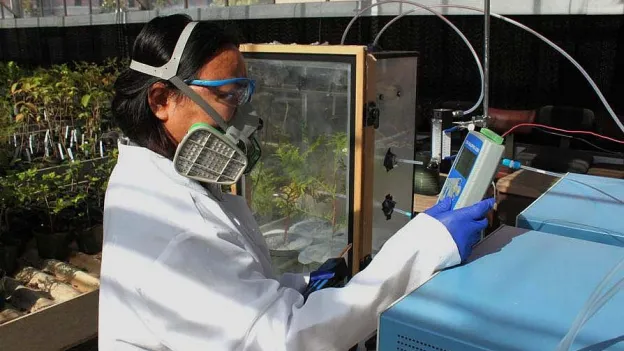
Solve the world’s biggest challenges
You are ready to tackle the complex environmental issues facing our planet. By blending coursework in science, math and policy, this program provides the practical tools you need to make a lasting, real-world impact.
Define your own research
Tailor your experience by choosing between a thesis or non-thesis track. The thesis option allows you to conduct original research, while the non-thesis option focuses on advanced coursework and a comprehensive examination.
Expand your perspective
You can boost your degree with a graduate minor in geospatial science. This nine-hour minor sharpens your technical abilities and opens doors to various new career paths.
See curriculum
RequirementsAre courses face-to-face?
Yes.
Is the GRE required?
Yes.
What are my capstone options?
There are two options.
1. Non-thesis track with a comprehensive exam
2. Research thesis
Apply to the environmental science master's program
To be eligible for consideration into the program, you must:
- meet SFA's graduate school requirements
- achieve an undergraduate 2.8 GPA or higher overall
- and be one of the following:
- in your final year of undergraduate work
- holding a bachelor’s degree from a regionally accredited college or university
- or have 95 or more semester hours of undergraduate work at SFA and be approved as an overlap student.
Ready? Complete the graduate school application.
If your college transcripts don't show a strong science background, you may be required to take certain leveling courses once you join the program.
Related News

Questions?
Get in touch! We're here to help.
Department of Environmental and Geospatial Sciences
Human Services Building, Suite 312