
 Axe ’Em, Jacks!
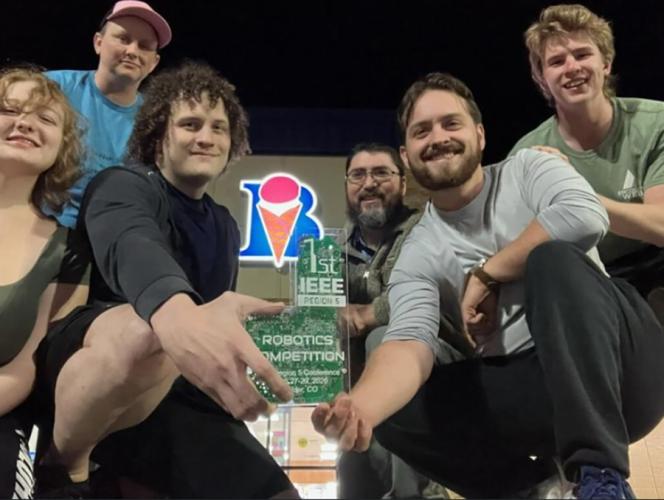
NACOGDOCHES, Texas –– Stephen F. Austin State University’s IEEE Robotics Team captured first place at the IEEE Region 5 Robotics Competition in March in Boulder, Colorado. SFA engineering students competed against 25 teams from 23 universities to earn top honors at the prestigious event sponsored by the Institute of Electrical and Electronics Engineers’ Southwestern U.S. region.
“This is an outstanding accomplishment for our students and a testament to their dedication, creativity and engineering skill,” said Dr. Rick McDaniel, chair of SFA’s Department of Physics, Engineering and Astronomy. “Winning at the IEEE Region 5 level demonstrates that our students can compete — and win — against some of the best programs in the region.”
The competition brings together top engineering students from Arkansas, Colorado, Kansas, Louisiana, Missouri, Nebraska, New Mexico, Oklahoma, South Dakota, Texas, Wyoming and a portion of Illinois to design, build and program fully autonomous robots that can sense their environment, make decisions and execute tasks without human intervention.
“SFA’s team distinguished itself through innovation, technical excellence and strong system integration,” said Dr. Hector Ochoa, assistant chair of the department and faculty advisor for SFA’s IEEE Robotics Team. “Success requires a combination of mechanical design, embedded systems, programming and control systems — skills that are central to SFA’s engineering and computer science programs.”
The five students representing SFA at the competition were Aaron Boehm, Ashley Brewster and Dalton Cardwell, all mechanical engineering seniors from Kingwood, Center and Arlington, respectively, and Kevin Claypool and Dustin Judson, electrical engineering seniors from Liberal, Kansas, and Nacogdoches, respectively. Maegan Honeycutt, first-year electrical engineering student from Humble and incoming team member, traveled with the team to assist and learn about the competition.
“Competing in IEEE Robotics taught me how important teamwork, communication and problem-solving are when working on a complex project,” Brewster said. “I learned how to adapt quickly when challenges came up and how to apply engineering concepts in a real-world environment. This experience will help me in the future by preparing me to work effectively on technical teams and solve problems under pressure.”
Cardwell said the IEEE competition helped push him beyond theoretical mathematics into the production of a functioning physical system. He agreed with Brewster on how critical teamwork is to the engineering process.
“I’ve seen that complex projects cannot be done alone but need the cooperation of great minds and great hands,” he said. “The determination, foresight and understanding of mechanical and electrical systems that I have gained from this competition will be useful for the rest of my life as I seek to better the world as an engineer.”
Boehm said the teamwork involved in the event reshaped how he approaches engineering.
“The mechanical and electrical components have to operate together without conflict, which required constant coordination and input from the team,” he said. “That pushed me to move away from focusing on isolated ideas and, instead, build designs that are cohesive and practical to manufacture. I now prioritize efficiency, reliability and building systems that perform consistently under real conditions, which is directly aligned with where I want to go in robotics and advanced systems.”
McDaniel said the SFA IEEE Robotics Team’s victory highlights the growing strength of hands-on, project-based learning opportunities within the university’s programs, particularly in robotics, automation and mechatronics.
“Our students are applying what they learn in the classroom to solve real engineering challenges,” he said. “This win reflects countless hours of design, testing, troubleshooting and teamwork. SFA’s continued success in competitions like this reinforces the university’s commitment to preparing students for high-demand careers in engineering, robotics and advanced manufacturing.”
Claypool said that SFA's resources and support were driving factors in the team’s victory.
“This success was made possible in large part by the resources and support provided by SFA, including access to equipment for printed circuit board manufacturing, 3D printing and soldering as well as the consistent guidance of Dr. Ochoa and support of the EE department, enabling us to turn our whiteboard concepts into a functional and competitive system,” he said. “The project will stand as a significant component of my résumé, and demonstrates not only technical capability but also adaptability and systems-level thinking.”
Judson said the team members’ passion and ability to work well together were also driving factors.
“Motivating college students to commit more than 30 unpaid hours a week on top of classes is like asking a band to play all night for free; only passion keeps them on the stage,” Judson said. “That same passion drove our team to design and build an amazing robot and carry it to victory. But like any great band, it only worked because everyone stayed in sync and played their part. I learned that leadership is not about taking the spotlight for yourself, but about creating the conditions for others to excel.”
For more information on SFA’s engineering programs, visit sfasu.edu/engineering.