A career you love is good for the heart
Be prepared to enter the high-demand medical field upon graduation! Your education at the DeWitt School of Nursing shapes you into a highly respected professional. Most students even lock down their job offers before they finalize their degrees.
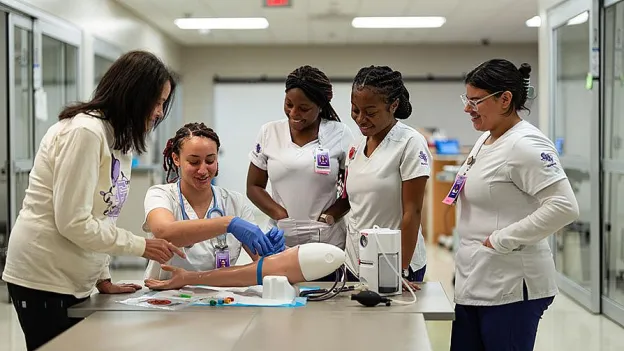
Your training goes far beyond the textbook. You will work alongside professors in actual clinics and hospitals. This immersive approach ensures you confidently step into any medical center or rural clinic.
Two phases to graduation
The 120 credit-hour Bachelor of Science in Nursing is divided into two distinct components.
- You'll spend your first two years on university core curriculum and foundational sciences. This pre-nursing foundational coursework must be completed before you apply to the School of Nursing.
- Once accepted into the nursing program, you'll dive into 53 hours of dedicated clinical-nursing courses.
Pre-nursing foundational coursework
You must finish these core science and elective prerequisites before applying to the School of Nursing:
- Anatomy and physiology with labs
- Introductory or general chemistry with lab
- Microbiology for science or non-science majors with lab
- Pathophysiology
- Introduction to probability and statistics
- Human development across the lifespan
- Introductory nutrition and general psychology
Clinical-nursing courses
Once accepted into the major for your final two years, your schedule features a rigorous blend of classroom lecture and active clinical practicums. You'll focus on wellness promotion, health assessment, mental health nursing and fundamental care skills.
Your final semesters shift to community health, maternal-child specialties, complex care and nursing leadership.
You will also select two credits of specialized nursing electives. Options include topics like healthy aging, women's health issues or holistic grieving.
Resources
The student handbook goes in depth on expectations, requirements, evaluation procedures and more. When considering whether SFA's Bachelor of Science in Nursing is a proper fit for you, be sure to read through this handbook.
The baccalaureate nursing program at Stephen F. Austin State University is accredited by the: Accreditation Commission for Education in Nursing (ACEN), 404.975.5000, acenursing.org, 3390 Peachtree Road NE, Suite 1400 Atlanta, GA, 30326. The most recent accreditation decision made by the ACEN Board of Commissioners for the baccalaureate nursing program is continuing accreditation. View the public information disclosed by the ACEN regarding this program on the ACEN website.
Information below is provided in compliance of ACEN accreditation requirements.
See curriculum
Requirements Degree mapIs this program accredited?
Yes, by the ACEN.
How long will it take to complete?
Four years of full-time study.
Two years of pre-nursing and two years of clinical nursing.
Important deadlines
NursingCAS must receive and verify your application by:
- March 15 for Fall enrollment
- Sept. 15 for Spring enrollment
How long can verification take?
It can take six weeks for NursingCAS to verify a submitted application.
Program Highlights
Applying to the BSN program
The pre-licensure BSN program application is a two-part process. Your acceptance into the program is contingent upon successful admission to SFA and completion of required prerequisite coursework.
All the information you need is below, or you can view the printable application instructions. Reference: SON HOP 3.7.
Frequently Asked Questions
The majority of your prerequisite courses must be complete. You may be enrolled in the remaining prerequisite courses during the time of application.
There are some courses that are not required for admission to the School of Nursing, but are required for graduation. You must have no more than four of those courses complete at the time of program entry.
The Test of Essential Academic Skills is offered by SFA's Testing Services.
Visit the ATI website for more locations.
Hospitals with magnet designation are required to employ nurse managers and leaders with a minimum baccalaureate degree in nursing. These facilities also require that at least 80% of their nurses have a bachelor’s degree or higher.
Obtaining a BSN keeps doors open for graduate school, where you may study to become a nurse practitioner, nurse educator or nurse anesthetist.
No. We expose you to a variety of nursing specialties. You'll take courses in medical surgical, psychiatric care, pediatrics, women’s health and critical care.
Our graduates are competitive in any specialty, and many of our students have secured jobs in prestigious hospitals and specialty units upon graduation. The School of Nursing is committed to ensuring your success on the national licensing exam and preparing you to excel no matter where you choose to work.
Related News

Questions?
Get in touch! We're here to help.
DeWitt School of Nursing
DeWitt School of Nursing Complex, Suite 102