
A future defined by discovery
Physics reveals how the universe works. You'll gain the technical skills and sharp insights needed to solve complex problems and build a career that truly changes the world. Get ready to go beyond our classroom lectures. You'll work alongside passionate professors and conduct real research. You may even get published before you graduate.
Turn theory into action
Whether you aim for professional research, engineering, medicine or teaching, this program builds the strong scientific foundation you need. You will focus your studies through a distinct concentration, choosing between general physics, biomedical, or secondary teaching.
Hands-on research facilities
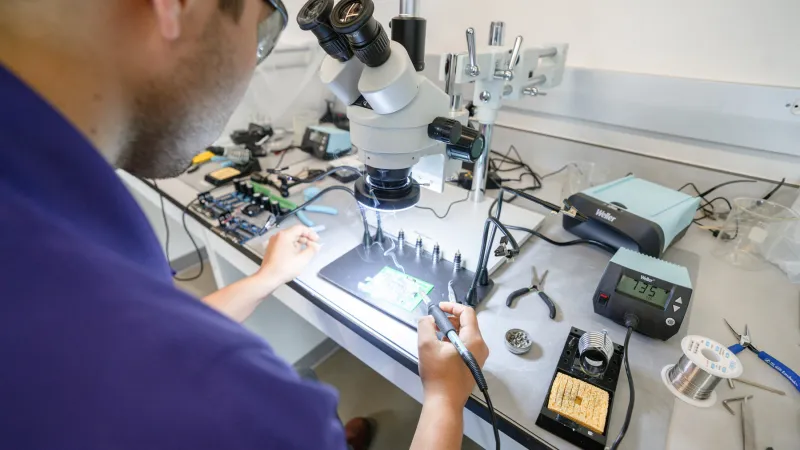
Experience science firsthand in our specialized labs. You’ll have access to:
- Student observatory: Utilize the largest student observatory in Texas.
- Quantum optics lab: Explore advanced optical phenomena.
- Engineering spaces: Work in our machine shop and makerspaces.
- Research centers: Access our low-temperature, gas dynamics and remote sensing labs.
See curriculum
RequirementsIs a concentration required?
Yes.
Select your physics concentration
The 120 credit-hour physics program designates specific paths based on your career goals.


Requirements for admission to SFA
All applicants must meet the undergraduate admission requirements. Select the option that best describes you:
- First-year student (have never enrolled in college)
- Transfer student (have enrolled in college)
- All other applicants
Ready to complete your application?
Undergraduate applications are accepted online. Apply using ApplyTexas or Common App. Both are fine, just only submit one.
Apply with ApplyTexas Apply with Common App
Priority deadlines
SFA has rolling admissions. That means you can apply to the university anytime. Although, applying early has financial and housing benefits. Make sure to check with your specific department! Some programs need extra paperwork by a certain date to consider you for the upcoming semester.
Related News
Related Events
Questions?
Get in touch! We're here to help.
Department of Engineering and Construction Sciences
STEM Building, Suite 207