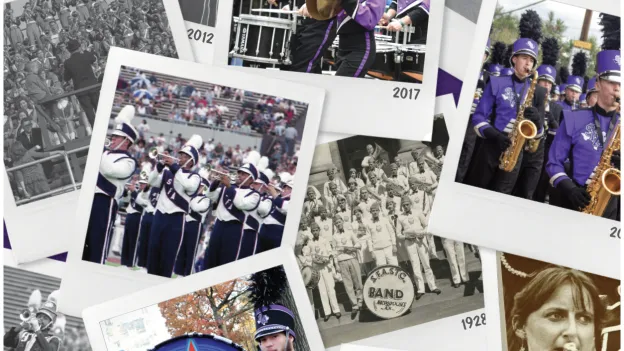
To tell the story of Stephen F. Austin State University,
one must also tell the story of the Lumberjack Marching Band.
For 100 years, the band has been woven into the fabric of the university’s treasured tradition and spirit. Whether bringing a stadium to life with the timeless tune of “Wabash Cannonball” or representing the university on the grandest stages, LMB has served as the anthem and symbol of Lumberjack pride.
“I have seen the last 34 years of LMB, so I have long seen how they have upheld traditions and, in many cases, even initiated things that have become tradition,” said Dr. Gary Wurtz, dean of the Micky Elliott College of Fine Arts. “Year in and year out, they have been the strongest voices in the stadium, and their presence and the quality of their music is undeniable. They have earned the respect and admiration of the fans. Everywhere I go, people comment on the quality and spirit of the band, and they express their appreciation for their commitment to the team and the institution.”
Evolution of LMB
By its third year, Stephen F. Austin State Teachers College had grown far beyond its modest beginnings. Under the leadership of Dr. Alton W. Birdwell, SFA’s first president, the Austin Building rose on campus, the campus community chose the formidable Lumberjack as the university’s mascot, Bob Shelton launched the football program, and new courses and electives expanded opportunities for students.
The university had its identity. What it lacked was a soundtrack.
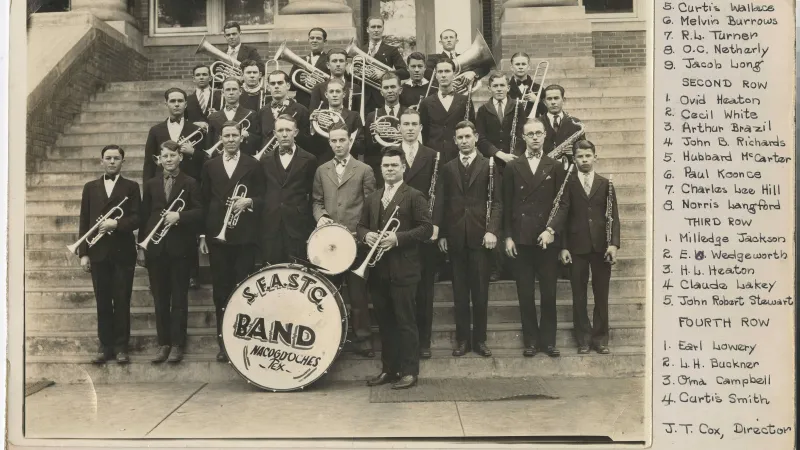
SFA purchased its first brass and percussion instruments and hired John T. Cox as the university’s first director of bands in 1925. Cox’s inaugural band in fall 1926 was humble — 15 members, including Cox himself filling in on cornet — but the group performed anywhere it could, from athletic events and chapel services to watermelon feasts and other local events. By 1930, the growing ensemble staged its first halftime show, forming letters, presumably “SFA,” on the football field.
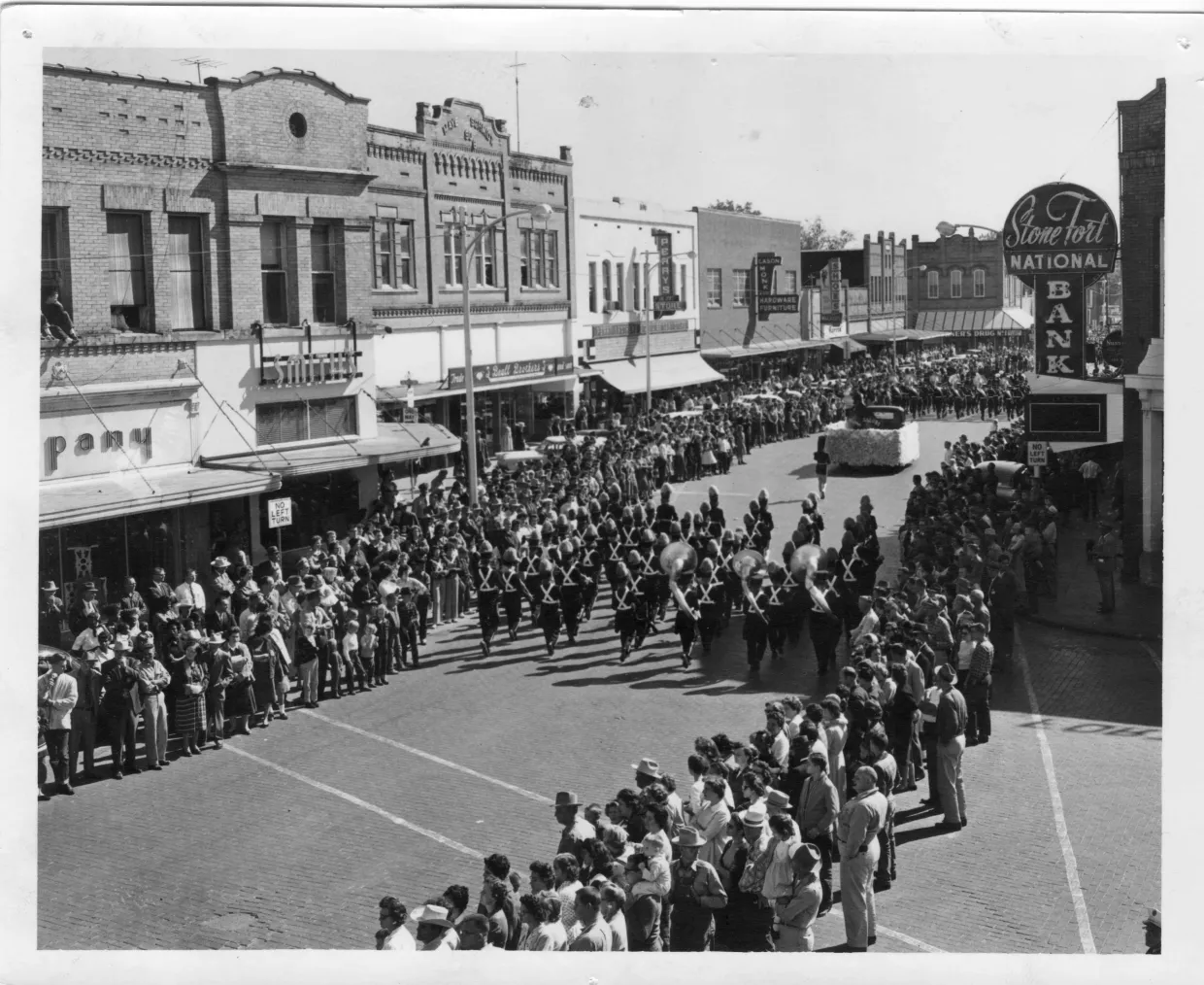
Over the decades, the band evolved alongside the university, weathering the challenges of World War II and embracing new traditions under successive directors. From Jimmie Hudgins, who introduced the band’s military style marching identity and expanded student traditions, to Mel B. Montgomery, who adapted to corps-style drills while later adding the military-style pregame show. Today, SFA remains one of the few universities in the country to perform both styles during football games. This reflects the program’s goal to balance innovation with tradition over the last century.
“One of the most unique things about LMB is that we honor our East Texas military roots by continuing to include military marching in our pregame show,” said Dr. Dan Haddad, associate director of bands and LMB director. “Beyond that, the level of performance and quality of playing put LMB alongside some of the best college bands in the country.”
SFA’s first band, directed by J.T. Cox. Beginning with 15 members, including Cox filling in on cornet, the ensemble grew steadily to more than 20 musicians during its first year. 1926-27
Marching in the spotlight
Throughout the years, LMB established itself as one of the premier programs in Texas and gradually gained traction as one of the best in the country. What followed propelled the program into the international spotlight.
Under the direction of Dr. David Campo, SFA director of bands, 2018-21, and LMB director, 2004-17, and Dr. Tamey Anglley, current director of bands and LMB director, 2018-21, LMB performed in the 2013 London New Year’s Day Parade and Festival, watched by more than 600,000 spectators and televised to 280 million people worldwide.
Two years later, the band earned the sought-after invitation to perform in the 2015 Macy’s Thanksgiving Day Parade, bringing the spirit of SFA to one of the country’s most iconic events and a televised audience of approximately 22.3 million viewers.
Fred J. Allen, SFA’s director of bands, 1994-2018, marched alongside the band during the Thanksgiving tradition and still remembers the magnitude of the moment.
“It really hit me later when I saw some of the drone photos showing the massive crowds lining the avenues and even hanging out of windows,” Allen said. “Finally, the whole world was seeing what we already knew in the piney woods: SFA has a great marching band.”
LMB returned abroad in 2017 to perform in the world-famous St. Patrick’s Day Parade in Dublin, Ireland, joining performers from around the globe for Ireland’s largest annual celebration.
Following its centennial year, LMB will once again perform on the streets of London for the 2027 London New Year’s Day Parade and Festival.
“Our first international trip in 2013 really changed the trajectory of the Lumberjack Marching Band,” Anglley said on the effect of the performances. “It’s really incredible to think about the impact this band has had on thousands of students, and the experiences we were able to give them that changed their lives.
The calm before the cadence
LMB mellophone player Keziah Knight’s preshow routine has always been the same:
Find her first dot — check.
Map out the opening sets — check.
Whisper a prayer — check.
It’s how she quiets the noise, if only for a moment. Once she steps onto the field, there’s no quiet at all, only the rush of adrenaline and the excitement of performing a drill that has captivated an audience for a century.
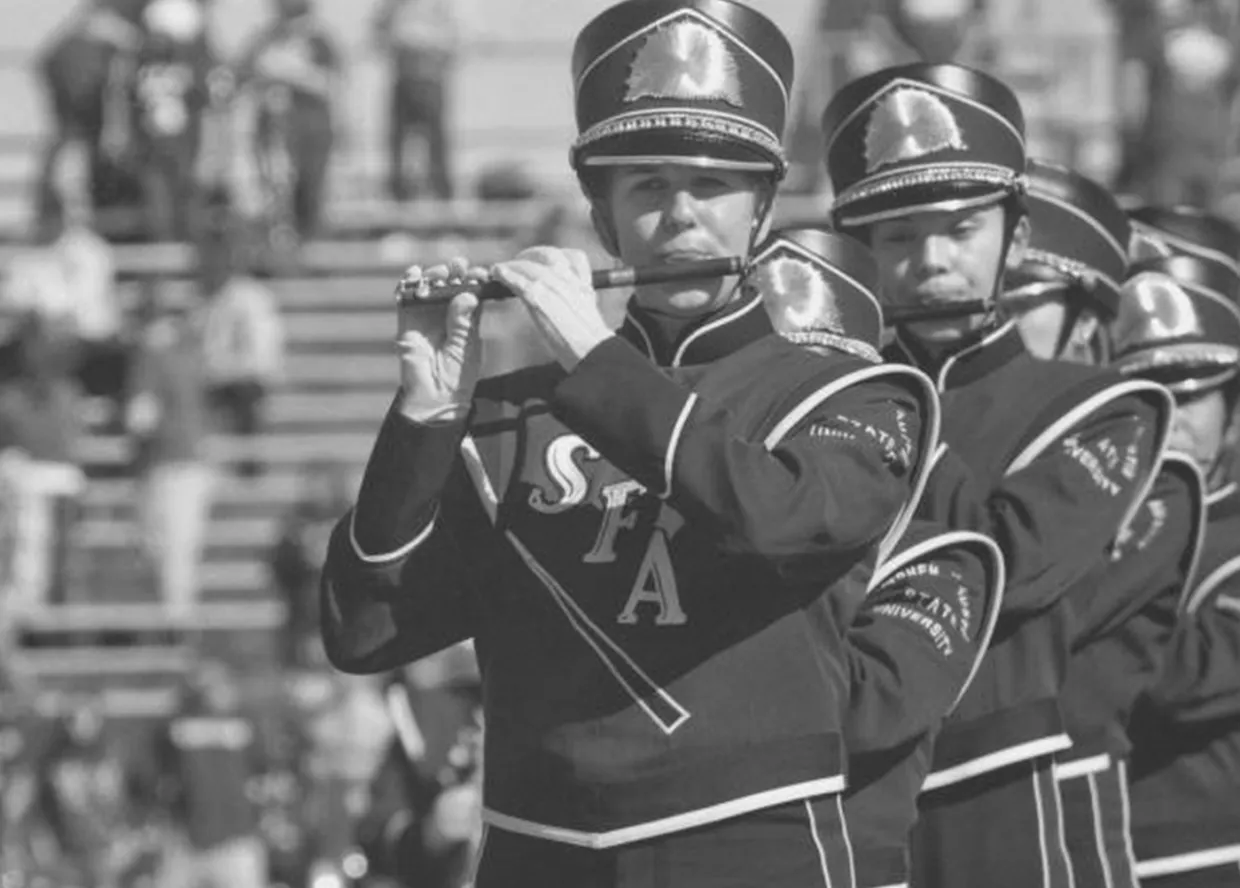
“Stepping onto the field before a show is one of the most rewarding experiences because you get the opportunity to share something you love with so many people,” Knight said.
In the program’s centennial year, Knight will channel that energy into a new role as drum major, leading the band she loves from the home sideline to London’s 2027 New Year’s Day Parade and Festival.
“I am incredibly grateful to be able to be a part of this monumental season — not only to represent our program as it is right now but to honor the Lumberjack Marching Band through its 100-year past and leave a legacy for what is to come,” Knight said.
The sound of Saturdays
SFA Football Head Coach Colby Carthel had never been so emotional before a game.
It wasn’t just the momentum of an 11-win 2025 season or the weight of facing Montana State University — the pinnacle of the Football Championship Subdivision and eventual national champion. It was what waited for him when the hotel doors opened.
Nearly 1,600 miles from Nacogdoches, 120 LMB members stood in formation. Then the fight song cut through the frigid air, declaring the Lumberjacks’ arrival.
“We’re walking out of our hotel in Bozeman, Montana, in the middle of December, and there LMB is,” Carthel said. “That doesn’t happen many places at all in college football. It was incredible.”
Moments like that aren’t the exception but the reflection.
For decades, whether on the field at halftime or in the stands, LMB has shaped the game day experience in ways that go beyond music by serving, as Campo aptly puts it, a rallying point for school spirit.
They are a constant presence, steps from the Purple Haze student section, where axe handles slam in rhythm and the noise builds with every snap. The band knows when to swell and when to hold back, when to spark the crowd and when to let the moment breathe.
For the Jacks, it’s energy.
For the fans, it’s tradition.
For the opponent, it’s a relentless noise that never disappears.
For Carthel, LMB is a “football coach’s dream.”
“I’m very fortunate to lead a football program that is supported by such an outstanding band,” Carthel said. “LMB is top of their class and big in numbers, and big in what they tackle and take on as a unit and as a program.”
Fun Fact:
In the days leading up to the 2025 FCS game against Montana State, members of the LMB joined the football team's morning practices and played as loud as they could to get the football players accustomed to the deafening atmosphere they would find at Bobcat Stadium.
SFA didn't have a single false start penalty in the game.
A family in formation
Overlooking the blistering, sunbaked commuter parking lot where LMB and the Twirl-O-Jacks pour countless hours into perfecting their performance hangs a sign that says it all: “LMB — Not just a band, a family.”
While audiences see polished drills and hear pristine sound on the field, band members know a different reality built in the early mornings, long rehearsals and shared moments that slowly turn strangers into family. For many students — music majors or not — it becomes a deep sense of belonging that endures long after their time at SFA.
“There are so many students who met their future spouses in the band, so many music education students who have graduated and gone on to illustrious careers as band directors. And, most telling to me, a great number of students who still stay in touch with us and each other,” Campo said. “My hope is that as we evolve, we don’t lose sight of the importance of human connection, and that’s what LMB has always been about.”
For Doice Grant ’82, LMB represents a shared legacy that spans generations and connects parents and children through the same traditions and values.
“I am very proud that both my parents and my children were in LMB and very proud of the standard the early bands set for musical quality and social comradery,” Grant said.
Regardless of when they graduated or what halftime show they performed, LMB members share the same constant.
They all bleed purple.
“What stands out to me are the thousands and thousands of people who have been impacted by this program and have this amazing ensemble in common,” Anglley said. “It doesn’t matter what year you graduated or which director you were under, we all bleed purple and still have the SFA alma mater memorized.”
For 100 years more
They aren’t hard to find. Follow the sound and you will find LMB, and, in turn, you will find SFA.
J.T. Cox didn’t just create a band; he established a lasting beacon of tradition, pride and spirit, one that summons generations of Lumberjacks home and has been sustained by the stewardship of the devoted directors who followed.
For this century and the next, LMB will remain the soundtrack of SFA’s enduring tradition and spirit.
“Know your job. Do your job.” ★

70 years of twirling
The story of the Lumberjack Marching Band isn’t complete without the Twirl-O-Jacks.
The precise and mesmerizing twirling line has been a staple of LMB and SFA tradition for decades, adding grace, poise and style to football games, parades and performances.
Originally dubbed the “Jack-ettes” before then-director of bands Jimmie Hudgins renamed them the “Twirl-O-Jacks” in 1956, the group’s signature style — shaped by former head twirler Pat (Griffin) Bridges — helped define LMB’s visual identity for generations of fans.
Among the many standout performers to don the purple and white, Paige Pattillo- Brown ’00 said being a feature twirler at SFA was a dream come true. A seven-time national champion during her time twirling at the university, she also placed second at the 1999 International World Trials for a three-baton performance.
“It was a dream come true every time I performed,” said Pattillo-Brown, daughter of the late Dr. Baker Pattillo, who served as university president from 2006 through 2018. “Looking at the audience dressed all in purple clapping to ‘Wabash Cannonball’ or the ‘SFA Fight Song’ will take your breath away. There were so many times during performances I would think, ‘I wish everyone could have this feeling.’ Now that I am a mother, I can say the feeling is pretty close to having a child. The endorphin rush is phenomenal, the power of the moment is so intense and, in those moments, you know there is a God.”
Candice (Pelzl) Curbow ’04, former head twirler and current TOJ coordinator, hopes the twirling line will continue to embody the elegance, discipline and spirit that became synonymous with the LMB experience.
“I hope people remember the twirlers as classy and talented entertainers and appreciate the skill it takes to be a baton twirler,” Curbow said. “I also hope they remember the twirlers as adding a little extra sparkle to the halftime show.” ★