The excitement in the stadium is building. A sharp cadence suddenly cuts through the night. The crowd cheers as the drill team takes command of the field.
The dancers’ high kicks, jump splits and precision steps mesmerize audience members. They have the late Denard Haden ’29, a beloved SFA alumnus and faculty member, to thank for that.


His legacy lives on not only through the students he taught and inspired but also through the new names of SFA’s Denard Haden School of Theatre and Dance, the Denard Haden Performance Hall and the Denard Haden Dance Studio in the Griffith Fine Arts Building.
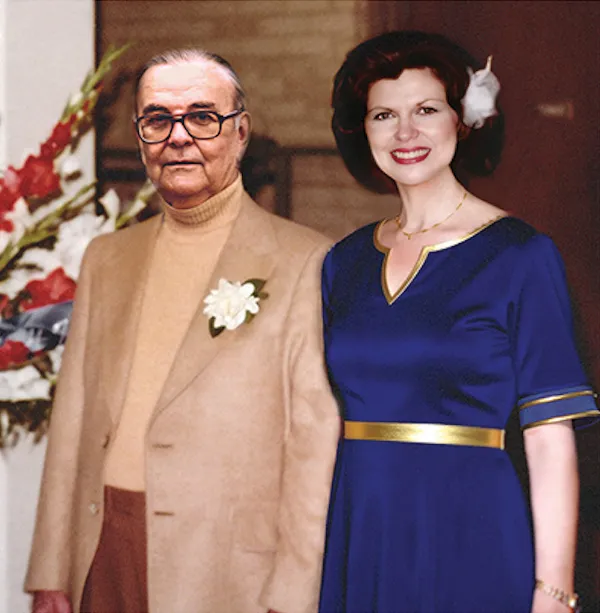
“My uncle’s influence can still be seen and felt today — not just within our family, but across this area and beyond,” said Haden’s niece and distinguished alumna Priscilla “Prissy” Abshier Sliva ’59, who made the generous commitment to enhance programmatic efforts and commemorate the legacy of her uncle. “To see his name recognized in a way that honors his legacy at SFA means so much to me.”
Dr. Gary Wurtz, dean of the Micky Elliott College of Fine Arts at SFA, said he is grateful to Sliva for her generosity and vision.
“Her gift not only supports the continued excellence of our theatre and dance programs but also honors a legacy that helped shape the foundation of dance education in East Texas.”
Haden's first dance
Haden established SFA’s dance program and was widely known for his creative vision and innovative choreography. He taught dance classes, choreographed musicals and introduced groundbreaking techniques that continue to influence dance and drill teams to this day.
“His gift for staging and movement left a lasting impression on generations of performers and students,” said Heather Samuelson, associate professor of dance at SFA.
But before he was a faculty member, Haden first stepped on campus in 1927 as a transfer student from Rice Institute, now Rice University, majoring in English. While at Rice in Houston, he took his first dance lesson. Haden mastered the steps so quickly he soon was asked to help as the instructor’s assistant. When his family relocated to Nacogdoches, he opened a dance studio and continued his studies at SFA until he earned his English degree in 1929.
After graduation, Haden taught English and served as principal at Corrigan High School during the week and gave dance lessons on the weekends. Determined to master his craft, he spent his summers studying with renowned instructors in California and New York, including Mary Wigman, Sergei Lifar, Alicia Alonso and Eduardo Cansino, Rita Hayworth’s father.
After five years, Haden realized dance was his true passion and began pursuing the craft full time. In addition to his Nacogdoches classes, he started teaching in Henderson in 1934. Demand led him to expand his classes to Kilgore. There, he met Gussie Nell Davis, one of his students who would go on to found the historically celebrated Kilgore College Rangerettes. In September 1940, the Rangerettes became the first drill team (dance team) to perform on a college football field.
Entering the national spotlight
Kilgore College presented Davis with a tough challenge: creating a show that would keep football fans in the stands during halftime. She had previously led a bugle drum corps that did not involve dancing. From the beginning, Haden taught her the routines, and Davis then taught them to the Rangerettes.
Haden was later drafted into the U.S. Army as a medic, serving in Europe during World War II. Upon his return, Davis asked Haden to join the Rangerettes as their first official choreographer, and he began teaching the line members directly. Haden’s signature number, known as the “Kilgore Rangerette Production Number,” is still the big finale of every “Rangerette Revels” spring show. The high kicks and intricate formations featured in the number continue to be integral to drill team performances.
Working closely with Davis, Haden helped shape a new standard for halftime entertainment, one that quickly spread from East Texas to high school and college stadiums across the country. During Haden’s more than 30 years with the Rangerettes, they were featured in the movie “Seven Wonders of the World” and made appearances on the “Ed Sullivan Show” and Dave Garroway’s “Wide Wide World.” They also performed at Madison Square Garden and continue to perform at the Cotton Bowl every New Year’s Day.
Lessons for Lumberjacks
In 1960, Haden returned to his alma mater to join the faculty at SFA, where he would spend more than a decade teaching modern dance and choreographing musicals such as “Camelot,” “Sound of Music,” “How to Succeed in Business Without Really Trying,” “My Fair Lady” and “Annie Get Your Gun.” At a time when formal dance education was still developing, Haden served as a dance pioneer at SFA, helping establish its emerging formal dance program. He approached every performance with artistry, discipline and a passion for storytelling.
“I never had the privilege of knowing Mr. Haden personally, but through his remarkable niece, Prissy, his legacy continues to inspire,” said Cleo House- Keller, director of the Denard Haden School of Theatre and Dance. “It’s my understanding that he shone brightly on stage, in the studio and under the stadium lights — and now, through this incredible gift, his influence will be felt for generations to come, especially by our theatre and dance students.”
Outside the classroom, he was a beloved member of the Nacogdoches community. Haden volunteered to help area high schools with their spring shows and offered free lessons to students who couldn’t afford them to ensure access to the arts for all. He also operated private studios in towns across East Texas, nurturing talent in Nacogdoches, Lufkin, Kilgore, Marshall and beyond.
During the height of his career, Haden worked with more than 1,000 students a year. His three requirements of each student were a desire to dance, a sense of rhythm and cooperation, according to the February 1964 Pine Log article.
Haden, who passed away in 1983, said he knew his place in history: “I feel that I have been a part of something truly great and I’ve helped to bring into focus a unique art form that is a true piece of Americana.”
The naming of the Denard Haden School of Theatre and Dance ensures future generations of SFA students will know Haden’s place in history, as well. For more information on how you can support SFA’s Micky Elliott College of Fine Arts, visit sfasu.edu/giving or call (936) 468-5406. ★