
 Axe ’Em, Jacks!
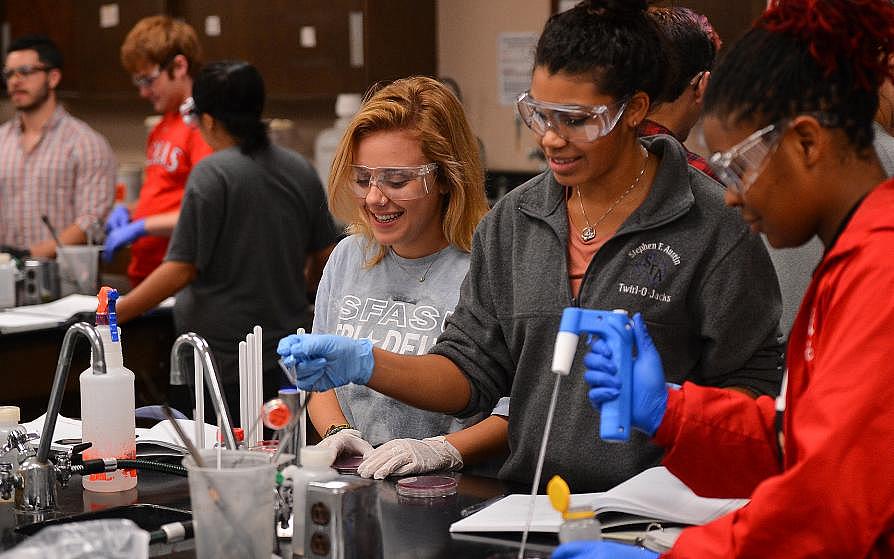
Undergraduate Research in Biology
The Department of Biology offers undergraduate students the opportunity to participate in hands-on, faculty-mentored research through BIOL 4195: Supervised Practicum in Advanced Biology.
This course provides students with a structured way to engage in independent research projects within the laboratories of department investigators. Students may earn between one to four credit hours per semester, with one credit corresponding to approximately 3 hours of lab per week. The course is offered in fall, spring and summer.
BIOL 4195: Supervised Practicum in Advanced Biology
- Open to sophomore through senior biology majors who have completed 18 hours of introductory biology coursework with a minimum of B average.
- Students work directly under the guidance of a faculty mentor, contributing to ongoing projects in areas such as genetics, molecular biology, cellular biology, aquatic biology, conservation ecology, animal physiology, cancer biology, microbiology, animal behavior and other disciplines represented in the department.
- Research experiences may culminate in a written report, presentation or poster suitable for departmental symposia or undergraduate conferences.
Benefits of Undergraduate Research
- Gain practical skills in laboratory and field techniques.
- Develop scientific communication and problem-solving abilities.
- Strengthen preparation for graduate school, medical school or careers in research, biotechnology and health sciences.